The Orchard group will be carrying out seasonal work in the Community Orchard on Sat 16 Mar between 1-3pm, please join us if available. We will be clearing weeds from around the fruit trees and putting compost around each tree. The orchard is in Stanks Park which is behind Mac's papershop at the East end of Lamond Drive. Tools will be provided, just bring gloves. For further information contact Henry Paul 07977-131635.
Monday, 11 March 2013

Tuesday, 16 October 2012
St Andrews Orchard Group - AGM
Hi,
Sunday 21 Oct is Apple Day. Please come to the Community Orchard (behind Macs papershop on Lamond Drive) at 2pm for a little tidying up session. I am then planning to hold an agm in my house (200m from Orchard) at about 4pm. Mulled cider will be on offer.
Henry Paul
Sunday 21 Oct is Apple Day. Please come to the Community Orchard (behind Macs papershop on Lamond Drive) at 2pm for a little tidying up session. I am then planning to hold an agm in my house (200m from Orchard) at about 4pm. Mulled cider will be on offer.
Henry Paul
Monday, 9 April 2012
Spring work party - Sat 28th Apr
Help is required on Saturday 28th April from 11am to 1pm to help clear the ground around the fruit trees. This helps the trees develop stronger roots and saves them competing with the grass for nutrients. It also means that the council workmen do not have to strim around the trees; a practice that can damage young trees.
Contact me (Henry Paul) if you have any questions.

Contact me (Henry Paul) if you have any questions.

Saturday, 11 February 2012
St Andrews Community Orchard – Wildflower Meadow project
We hope to change if from this:

Where the grass is cut every two weeks and no wildflowers are able to compete against the more invasive grass. To something more like this:
 An area where wildflowers will be established and the grassland will be mown once a year and the cuttings removed. We will use Yellow Rattle in our Organic conversion of this area into a Wildflower Meadow.

Yellow rattle is an attractive, semi-parasitic, grassland annual. In the past this plant was a serious pest for farmers as it weakens grasses and as a result can reduce hay yields by as much as 50%. In a landscape or garden context however, this suppression of grass growth is welcomed as it produces a better display of wild flowers and eases the mowing required.
Yellow rattle germinates late February to early March, flowers in June, and sets seed in July. At the end of each growing season as the annual yellow rattle plants die away they leave behind gaps into which new wild flowers can establish. As a result, wild flower seed sown into an existing sward will establish more readily in areas where yellow rattle already does well.

Where the grass is cut every two weeks and no wildflowers are able to compete against the more invasive grass. To something more like this:
 An area where wildflowers will be established and the grassland will be mown once a year and the cuttings removed. We will use Yellow Rattle in our Organic conversion of this area into a Wildflower Meadow.
Yellow rattle is an attractive, semi-parasitic, grassland annual. In the past this plant was a serious pest for farmers as it weakens grasses and as a result can reduce hay yields by as much as 50%. In a landscape or garden context however, this suppression of grass growth is welcomed as it produces a better display of wild flowers and eases the mowing required.
Yellow rattle germinates late February to early March, flowers in June, and sets seed in July. At the end of each growing season as the annual yellow rattle plants die away they leave behind gaps into which new wild flowers can establish. As a result, wild flower seed sown into an existing sward will establish more readily in areas where yellow rattle already does well.
Wednesday, 14 December 2011
Apple Press

The St Andrews Orchard Group have obtained an electric fruit shredder and a large apple press. These were paid for by a grant from the St Andrews Common Good Fund and are available to anyone who lives in St Andrews. The trugs of apples in the picture were crushed and juiced in half an hour and produced 60 litres of juice.
Saturday, 28 May 2011
Second planting in St Andrews Commonwealth Orchard
Fortyeight fruit trees were planted in March 2011 to complete the St Andrews branch of the Commonwealth Orchard. We had pupil and teacher volunteers from Canongate, Greyfriars, Madras additional support and Madras Eco club. We also had some community councillors and members of the public helping. The day was dreich but, all of the trees were planted.


Friday, 25 March 2011
Fruit Tree Planting Wednesday 30th March
Hi,
As part of Madras' Eco day we are planning to plant 50 more fruit trees in Stanks Park (behind Mac's papershop on Lamond Drive). We will meet at 1pm in the park and please bring a spade if possible.
If you require any further details pease contact me.
As part of Madras' Eco day we are planning to plant 50 more fruit trees in Stanks Park (behind Mac's papershop on Lamond Drive). We will meet at 1pm in the park and please bring a spade if possible.
If you require any further details pease contact me.
Sunday, 27 February 2011
Spring tree planting on Wednesday 30 March 2011
We have 50 mixed fruit trees and plan to plant them on Wednesday 30 March. The trees will be planted in Stanks Park, alonside the 28 trees planted last spring and the planting will be organised with Madras college as part of their efforts to secure a second Green Flag. I will post more details closer to the date.
Henry Paul
henrythenav@hotmail.com
07977-131635
Henry Paul
henrythenav@hotmail.com
07977-131635
Wednesday, 6 October 2010
2010 AGM - Sunday 17 October at 3pm in Botanics
The St Andrews Orchard Group will be helping out at the Apple Day at the Botanics on Sunday 17 October. We will hold our AGM, immediately after the day has finished, at 3:00pm in the Glass Class.
Please contact me if you have any agenda items you would like to discuss.
Please contact me if you have any agenda items you would like to discuss.
Friday, 3 September 2010
We have secured funding for 50 more fruit trees and we are looking for suggestions for different sites in St Andrews. If we do not have any other suggestions we will plant the trees in Stanks Park with the other 28 trees planted in March this year. The first batch of trees are doing well and only two appeared to have died.
Friday, 2 July 2010
Fruitful Scotland Volunteer Day
10am -3pm at Elmwood College Farm, Cuparmuir, KY15 5RN.
FREE - bring a sandwich - families welcome. Tools, gloves etc will be provided.
Come and volunteer on the new Orchard planted at Elmwood College as a training orchard to help people learn skills. The day will consist of some practical work, maintaining and developing the newly planted orchard. There will also be an opportunity to be shown how to do bud grafting - which is how apple trees are propogated. The volunteer day will be led by John Hancox, director of the Commonwealth Orchard, and Chair of Scottish Orchards, with Iain Hunter of Elmwood College.
We will also bring an apple press to make some juice - always popular with children.
Scottish Orchards is a new Scotland wide group (www.scottishorchards.com ) which aims to support fruit growing in Scotland and is open to anyone with an interest in growing, picking and using fruit. As well as preserving old varieties of fruit - the traditional skills of pruning, grafting and preserving fruit need to be continued. Passing this knowledge to younger people is very important. If you'd like to join Scottish Orchards or find out more about volunteering please contact John Hancox - john@commonwealthorchard.com 0778 6063918
FREE - bring a sandwich - families welcome. Tools, gloves etc will be provided.
Come and volunteer on the new Orchard planted at Elmwood College as a training orchard to help people learn skills. The day will consist of some practical work, maintaining and developing the newly planted orchard. There will also be an opportunity to be shown how to do bud grafting - which is how apple trees are propogated. The volunteer day will be led by John Hancox, director of the Commonwealth Orchard, and Chair of Scottish Orchards, with Iain Hunter of Elmwood College.
We will also bring an apple press to make some juice - always popular with children.
Scottish Orchards is a new Scotland wide group (www.scottishorchards.com ) which aims to support fruit growing in Scotland and is open to anyone with an interest in growing, picking and using fruit. As well as preserving old varieties of fruit - the traditional skills of pruning, grafting and preserving fruit need to be continued. Passing this knowledge to younger people is very important. If you'd like to join Scottish Orchards or find out more about volunteering please contact John Hancox - john@commonwealthorchard.com 0778 6063918
Saturday, 3 April 2010
Tree Planting on Easter Saturday 3 April 2010
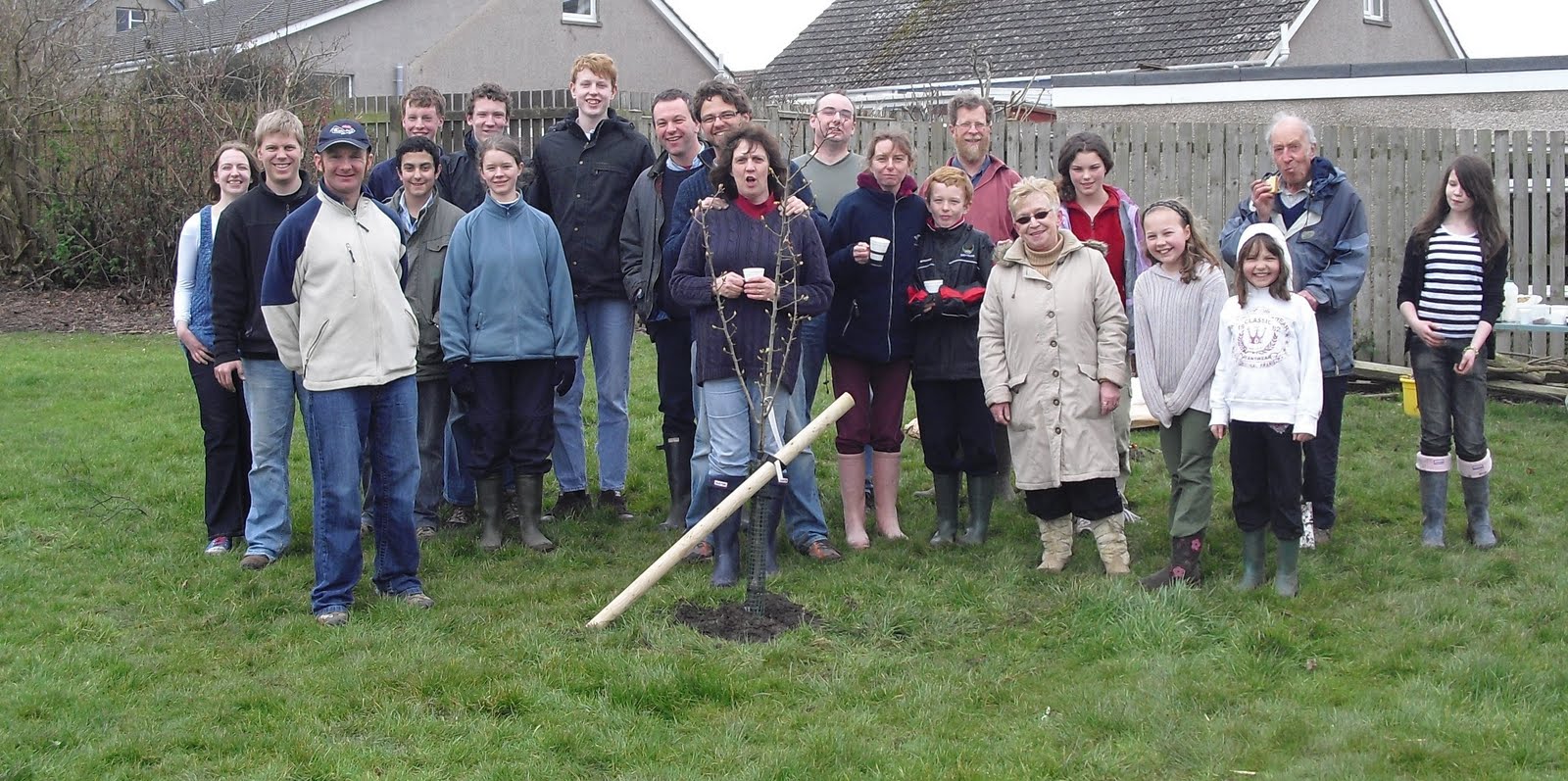
The St Andrews Orchard Group and volunteers have planted the first thirty trees to establish a branch of the Commonwealth Orchard in St Andrews. The Commonwealth Orchard is inspired by the 2014 Games coming to Scotland and builds on the successful track record of the Children's Orchard. The Commonwealth Orchard is being planted across Scotland and beyond, consisting of lots of small plantings, making a greater whole. Their vision is that children and families can all grow fruit near to where they live. Businesses, landowners, charities, local authorities, schools and communities can all create a fruitful Scotland. The first batch of trees were planted in Stanks Park, behind Macs papershop on Lamond Drive and these trees were donated by Fife Council, Fife Coastal & Countryside Trust and private donations. The St Andrews Orchard Group hopes to plant more trees in the Autumn and if you would like to help please contact Henry Paul




Monday, 29 March 2010
Fruit tree planting-Saturday 3 April 2010
The trees have been delivered and kept in my garden over winter and they will be planted on Saturday 3 April. If you would like to take part please meet at 1:00pm in Stanks Park (behind Mac’s papershop on Lamond Drive). I have trees, stakes, ties, tree-guards and compost but, I only have two spades so if possible please bring your own spade to help speed things along. If anyone is interested in helping please contact me for details and if possible adopt a tree, if you would like further information about this project please contact me by
e-mail: henrythenav@hotmail.com or 07977-131635
e-mail: henrythenav@hotmail.com or 07977-131635
Sunday, 20 December 2009
Tree planting postponed
Hi, Due to the frozen ground we will have to postpone the fruit tree planting in Stanks Park. I will be back in contact when I have had a chance to see what the weather will be like between Christmas and New Year. The trees are fine as I heeled them in when they arrived at the end of November and we can afford to wait until the weather is more suitable. Regards, Henry Paul 07977-131635
Thursday, 17 December 2009
St Andrews Orchard Group
The St Andrews Orchard Group will be planting 20 fruit trees in Stanks Park (behind Mac’s papershop on Lamond Drive) with the aim of establishing a Commonwealth Community Orchard in St Andrews. Fife Council has approved the establishment of the Orchard in Stanks Park, between Lamond Drive and Kilrymont Place, and they have funded the purchase of the first 20 fruit trees as per the website:http://standrewsorchardgroup.blogspot.com/ Planting will be on Monday 21 or Tuesday 22 December depending on the weather. If you would like to take part please meet at 1:00pm at the park and further details can be obtained from Henry Paul (07977-131635).
Saturday, 5 December 2009
The trees have been delivered and I am hoping to plant them either on the afternoon of Monday 21 or Tuesday 22 December depending on the weather. If anyone is interested in helping please contact me for details and if possible adopt a tree, if you would like further information about this project please contact me by e-mail: henrythenav@hotmail.com or 07977-131635 or view our blog: http://standrewsorchardgroup.blogspot.com/
Wednesday, 7 October 2009
Planned planting dates
Fife Council have approved the establishemnt of the Commonwealth Orchard in Stanks Park and they have funded the purchase of the first 20 fruit trees as per the order below. The trees will be delivered in mid-December and planted during the Christmas holidays. If anyone is interested in helping please contact me for details and if possible adopt a tree.
Henry Paul 07977-131635 or henrythenav@hotmail.com
Henry Paul 07977-131635 or henrythenav@hotmail.com
Sunday, 20 September 2009
Fruit tree list
The website for the trees is: www.butterworthsorganicnursery.co.uk
Dessert Apples
1. DISCOVERY - (A) (3) (N) (V2), Aug. - Sept.M27, M26, MM106, MM111(BEAUTY OF BATH X WORCESTER PEARMAIN)Bright red flushed apple, crisp and juicy, when left to ripen on tree. Tip and spur bearer. Recommended by most organic authorities. "The best early variety by far". (Geoff Hamilton)
2. KING OF THE PIPPINS - (B) (4) (S) (V2), Oct - Dec. MM106U.K.or France, probably about 1770. Also used for cooking and cider. An oblong shape, orange-red over gold. Bitter-sweet flavour.
3. JAMES GRIEVE - (C) (3) (S) (V2), Sept. M26,MM106, MM111 Well known Scottish apple originating near Edinburgh. The fruit is yellow,speckled and striped with orange. A good pollinator. Prone to canker, but can be good in the East.
4. OSLIN - (A/B) (2) (N) (V2) Sept., MM106.
Known 1815 but probably much older, associated either with Arbroath Abbey or Lindores Abbey, Newburgh, possibly originally French. Slightly scented, rich, distinctive taste with hint of aniseed
5. THORLE PIPPIN - (D) (2) (N) (V3) Tip Bearer, Sept., M26Scottish, first described 1831. A small, flat, red fruit with an agreeable if sharp taste.6. KATY - (A) (3) (N) (V3), Sept - Oct, M26, MM106(JAMES GRIEVE X WORCESTER PEARMAIN)Raised in Sweden, where known as Katja. Some of the flavour of each parent. Bright red flush on greenish-yellow background. Widely successful.
7. BLOODY PLOUGHMAN - (C) (3) (N) (V3) Sept - Nov. MM106, MM111Arose Carse of Gowrie about 1880. Named after a ploughman who was caught stealing the apples and was shot by a gamekeeper! A ribbed, red apple with a fine taste, better in the East unless sprayed for scab.
8. COUL BLUSH - (A/C) (2) (N) (V3) Sept-Nov, M26, MM111. Britain’s most northerly apple variety raised at Coul, Ross-shire in 1827. Gold with faint flush. Sweet, soft cream flesh. Also makes good sauce.
9. PEASGOOD'S NONSUCH (B)(3)(S)(V2), SEPT-OCT, M26Raised by a Mrs Peasgood, Grantham, Lincs. Around 1855. A handsome, large, orange-red brisk and juicy fruit which also cooks to a sweet puree.
10. NORFOLK ROYAL RUSSET - (A/B)(4*)(N)(V2) Sept-Dec., MM106Raised Norfolk, 1908 with Russet sport arising same area in 1970's. Known to do well in both the E. and W. of southern Scotland, with an excellent sweet-sharp flavour even at the end of it’s season.
11. CAMBUSNETHAN PIPPIN - (A) (4) (N) (V1) Part Tip Bearer Oct - Nov, MM106, Arose either in Clydesdale around 1750 or possibly earlier at Stirling. According to David Storrie "an excellent scab-free desert apple popular in both the east and the west."
12. RED WINDSOR (B)(2)(S)(V1), SEPT-OCT., MM106(RED SPORT OF ALKMENE, GEHEIMRAT DR. OLDENBURG X COX'S ORANGE PIPPIN)Cox-type with crisp, juicy flesh. Aromatic. Disease-resistant. Known to do well at 600 feet in central Scotland.
13. PORT ALLEN RUSSET - (A) (2) (N) (V3) Oct-Nov., MM106
Probably from the hamlet of the same name in Perthshire, age unknown. A conical russeted fruit with an even orange flush on yellow background. Brisk, rich flavour.
Cooking Apples
14. LASS O’GOWRIE - (D) (2) (N) (V3) Aug-Sept. MM106Perthshire, described 1883. Well-flavoured apple keeping shape when cooked.
15. STIRLING CASTLE - (B) (3*), S, V1, Sept. - Dec. M26, MM111Raised by John Christie, Stirling in 1820's. Widely planted in the 19th Century and a still valued garden variety in Scotland and elsewhere. Well flavoured green-yellow fruit. Compact growth
Pears
16. GORHAM - (B) (4) (N) (V2) Sept-Oct.Long, pale yellow pear, like "Williams" but less scab prone.
17. CONFERENCE - (B/C) (3) (S) (V2) Oct-NovThe best -known pear, can be excellent flavour but not scab-resistant, so best in drier areas. Partially self-fertile.
18. LOUISE BONNE OF JERSEY (B)(2)(N)(V2) Oct.Raised 1780, Normandy. Pale green with red flush. Sweet and juicy flesh. Known to do very well in parts of eastern Scotland.
Plum
19. OPAL - (D) (3) (S) (V1) July-Aug. Pixy, St Julian ‘A’A reddish-purple fruit with a similar superb flavour to "Victoria", very useful where bacterial canker is problematic, as in certain parts of the west.
20. RIVERS EARLY PROLIFIC (D) (2) (Part S) (V2) Pixy, St Julian A.
The best early cooking plum, also a good dessert when fully-ripe. A blue-purple fruit, hardy and prolific.
Dessert Apples
1. DISCOVERY - (A) (3) (N) (V2), Aug. - Sept.M27, M26, MM106, MM111(BEAUTY OF BATH X WORCESTER PEARMAIN)Bright red flushed apple, crisp and juicy, when left to ripen on tree. Tip and spur bearer. Recommended by most organic authorities. "The best early variety by far". (Geoff Hamilton)
2. KING OF THE PIPPINS - (B) (4) (S) (V2), Oct - Dec. MM106U.K.or France, probably about 1770. Also used for cooking and cider. An oblong shape, orange-red over gold. Bitter-sweet flavour.
3. JAMES GRIEVE - (C) (3) (S) (V2), Sept. M26,MM106, MM111 Well known Scottish apple originating near Edinburgh. The fruit is yellow,speckled and striped with orange. A good pollinator. Prone to canker, but can be good in the East.
4. OSLIN - (A/B) (2) (N) (V2) Sept., MM106.
Known 1815 but probably much older, associated either with Arbroath Abbey or Lindores Abbey, Newburgh, possibly originally French. Slightly scented, rich, distinctive taste with hint of aniseed
5. THORLE PIPPIN - (D) (2) (N) (V3) Tip Bearer, Sept., M26Scottish, first described 1831. A small, flat, red fruit with an agreeable if sharp taste.6. KATY - (A) (3) (N) (V3), Sept - Oct, M26, MM106(JAMES GRIEVE X WORCESTER PEARMAIN)Raised in Sweden, where known as Katja. Some of the flavour of each parent. Bright red flush on greenish-yellow background. Widely successful.
7. BLOODY PLOUGHMAN - (C) (3) (N) (V3) Sept - Nov. MM106, MM111Arose Carse of Gowrie about 1880. Named after a ploughman who was caught stealing the apples and was shot by a gamekeeper! A ribbed, red apple with a fine taste, better in the East unless sprayed for scab.
8. COUL BLUSH - (A/C) (2) (N) (V3) Sept-Nov, M26, MM111. Britain’s most northerly apple variety raised at Coul, Ross-shire in 1827. Gold with faint flush. Sweet, soft cream flesh. Also makes good sauce.
9. PEASGOOD'S NONSUCH (B)(3)(S)(V2), SEPT-OCT, M26Raised by a Mrs Peasgood, Grantham, Lincs. Around 1855. A handsome, large, orange-red brisk and juicy fruit which also cooks to a sweet puree.
10. NORFOLK ROYAL RUSSET - (A/B)(4*)(N)(V2) Sept-Dec., MM106Raised Norfolk, 1908 with Russet sport arising same area in 1970's. Known to do well in both the E. and W. of southern Scotland, with an excellent sweet-sharp flavour even at the end of it’s season.
11. CAMBUSNETHAN PIPPIN - (A) (4) (N) (V1) Part Tip Bearer Oct - Nov, MM106, Arose either in Clydesdale around 1750 or possibly earlier at Stirling. According to David Storrie "an excellent scab-free desert apple popular in both the east and the west."
12. RED WINDSOR (B)(2)(S)(V1), SEPT-OCT., MM106(RED SPORT OF ALKMENE, GEHEIMRAT DR. OLDENBURG X COX'S ORANGE PIPPIN)Cox-type with crisp, juicy flesh. Aromatic. Disease-resistant. Known to do well at 600 feet in central Scotland.
13. PORT ALLEN RUSSET - (A) (2) (N) (V3) Oct-Nov., MM106
Probably from the hamlet of the same name in Perthshire, age unknown. A conical russeted fruit with an even orange flush on yellow background. Brisk, rich flavour.
Cooking Apples
14. LASS O’GOWRIE - (D) (2) (N) (V3) Aug-Sept. MM106Perthshire, described 1883. Well-flavoured apple keeping shape when cooked.
15. STIRLING CASTLE - (B) (3*), S, V1, Sept. - Dec. M26, MM111Raised by John Christie, Stirling in 1820's. Widely planted in the 19th Century and a still valued garden variety in Scotland and elsewhere. Well flavoured green-yellow fruit. Compact growth
Pears
16. GORHAM - (B) (4) (N) (V2) Sept-Oct.Long, pale yellow pear, like "Williams" but less scab prone.
17. CONFERENCE - (B/C) (3) (S) (V2) Oct-NovThe best -known pear, can be excellent flavour but not scab-resistant, so best in drier areas. Partially self-fertile.
18. LOUISE BONNE OF JERSEY (B)(2)(N)(V2) Oct.Raised 1780, Normandy. Pale green with red flush. Sweet and juicy flesh. Known to do very well in parts of eastern Scotland.
Plum
19. OPAL - (D) (3) (S) (V1) July-Aug. Pixy, St Julian ‘A’A reddish-purple fruit with a similar superb flavour to "Victoria", very useful where bacterial canker is problematic, as in certain parts of the west.
20. RIVERS EARLY PROLIFIC (D) (2) (Part S) (V2) Pixy, St Julian A.
The best early cooking plum, also a good dessert when fully-ripe. A blue-purple fruit, hardy and prolific.

Tuesday, 28 July 2009
I am proposing to establish a Community Orchard in St Andrews and if you would like further information about this project please contact me by e-mail henrythenav@hotmail.com or 07977-131635.
The reasons for setting up a community orchard are as follows:
1. To reduce the amount of CO2 produced in St Andrews by planting 20-30 new trees.
2. Encourage local people to value the fruit they produce in their own gardens.
3. Allow people with small/no garden to help grow fruit.
4. Reduce food miles if produce is sold at the local farmer’s market.
5. Educate children in local schools about fruit growing.
Community orchards are not a new idea and Fife Council helped establish a 70 tree orchard at Newburgh and the following is copied from the Newburgh Community Orchard website.
http://www.communityfoodandhealth.org.uk/
Newburgh Orchard Group
Newburgh Orchard Group is a voluntary organisation whose activities take place in Newburgh in North East Fife. Its activities involve the picking and sale to the public of plums, apples, pears and other fruit grown in private orchards in Newburgh and the immediate area. It also organise demonstrations of tree pruning and fruit recipes. Funding was obtained for a survey which has identified over 1000 fruit trees in Newburgh including some rare varieties.
The Orchard Group has worked with local primary schools to introduce children to local fruit and fruit growing, and has worked with Fife Council to establish a community orchard of 80 fruit trees next to Newburgh Primary School. The involvement with schools aims to develop an interest in fruit growing in the young, and through their influence get their parents on board, as well as encouraging healthy eating and reducing food miles. It aims to encourage people who have fruit trees in their gardens to value their trees and look after them so that the 900-year old heritage of fruit growing in Newburgh will continue and develop.
The Group was set up about five years ago as an offshoot of the local History Society. It works with local schools, Fife Council and WECAN! (Working for Environmental Community Action Now, based in Crosshill, Fife). It has also worked with Edinburgh Community Food Initiative and with an online restaurant supplier, and has been interviewed by Radio Scotland and featured in the Landward TV programme. The Group will be collaborating with the Fife Arts Cooperative whose resident artist will develop a community project on the topic of The Land.
The Group believes that its activities will preserve the fruit growing heritage which was begun by the monks of Lindores Abbey in the 12th century, and will also have an economic benefit to the town through the sale of fruit and through related tourism.
Our annual fruit sales, based at a stall in Newburgh High Street, have increased every year in the weight and value of fruit and the number of jars of home made jam sold to the public. Most of the money from the sales is passed back to the local people who grow the fruit.
Some customers travel considerable distances to buy the plums, and they often spend money in the shops and cafés in Newburgh.
The amount of fruit which is picked by the orchard owners (rather than fruit which they have allowed the Group to pick) has increased as a proportion of the total, showing that the owners are taking a greater interest. Its main activities have grown but not changed, and the Group feels that this consistency is an important factor in its success. It has achieved this growth by surprising the orchard owners with the amount of money that their fruit has earned, and by targeted press releases to local newspapers and radio just before the fruit sales.
However, the number of people who are prepared to take an active role in the Group has diminished for various personal reasons.
Its plans are therefore focused on encouraging the growers to pick the fruit themselves, so that the continued success of the fruit sales will support its aims over the longer term.
"There are many courses and environmentally related events which look very worthy but tend to be time and money-consuming. Although funding may be available, with limited numbers of people who themselves have limited time and energy, it is important to maintain focus on the principal strategy. The Group have found it very useful to know someone whose horizons are broader and who can advise and make useful contacts."
"It takes a long time for people outside the core group to take the strategy on board and to begin to work with it, so the principal strategy should be easy to understand and down-to-earth, and consistency over a period of years is very important. Getting local politicians on board can be very useful. Every opportunity should be taken for publicity to reinforce the message and show it is working, and some originality will always help."
St Andrews Community Orchard
I am planning to use Stanks Park between Lamond Drive and Kilrymont Place. A plan of the location of this park is below.

I believe this park would make an ideal community orchard for several reasons. Firstly, the park is on a slope and is not suitable for ball games and has several signs forbidding the playing of any ball games in the park. Luckily, for the local footballers there are several more suitable parks within easy walking distance. Secondly, the main users of the park are dog walkers and an extension of its use to a community orchard would not affect them. Finally, the other users tend to be local youths on their bikes or playing in the wood alongside the stream. Again they should be able to carry on their activities.
The reasons for setting up a community orchard are as follows:
1. To reduce the amount of CO2 produced in St Andrews by planting 20-30 new trees.
2. Encourage local people to value the fruit they produce in their own gardens.
3. Allow people with small/no garden to help grow fruit.
4. Reduce food miles if produce is sold at the local farmer’s market.
5. Educate children in local schools about fruit growing.
Community orchards are not a new idea and Fife Council helped establish a 70 tree orchard at Newburgh and the following is copied from the Newburgh Community Orchard website.
http://www.communityfoodandhealth.org.uk/
Newburgh Orchard Group
Newburgh Orchard Group is a voluntary organisation whose activities take place in Newburgh in North East Fife. Its activities involve the picking and sale to the public of plums, apples, pears and other fruit grown in private orchards in Newburgh and the immediate area. It also organise demonstrations of tree pruning and fruit recipes. Funding was obtained for a survey which has identified over 1000 fruit trees in Newburgh including some rare varieties.
The Orchard Group has worked with local primary schools to introduce children to local fruit and fruit growing, and has worked with Fife Council to establish a community orchard of 80 fruit trees next to Newburgh Primary School. The involvement with schools aims to develop an interest in fruit growing in the young, and through their influence get their parents on board, as well as encouraging healthy eating and reducing food miles. It aims to encourage people who have fruit trees in their gardens to value their trees and look after them so that the 900-year old heritage of fruit growing in Newburgh will continue and develop.
The Group was set up about five years ago as an offshoot of the local History Society. It works with local schools, Fife Council and WECAN! (Working for Environmental Community Action Now, based in Crosshill, Fife). It has also worked with Edinburgh Community Food Initiative and with an online restaurant supplier, and has been interviewed by Radio Scotland and featured in the Landward TV programme. The Group will be collaborating with the Fife Arts Cooperative whose resident artist will develop a community project on the topic of The Land.
The Group believes that its activities will preserve the fruit growing heritage which was begun by the monks of Lindores Abbey in the 12th century, and will also have an economic benefit to the town through the sale of fruit and through related tourism.
Our annual fruit sales, based at a stall in Newburgh High Street, have increased every year in the weight and value of fruit and the number of jars of home made jam sold to the public. Most of the money from the sales is passed back to the local people who grow the fruit.
Some customers travel considerable distances to buy the plums, and they often spend money in the shops and cafés in Newburgh.
The amount of fruit which is picked by the orchard owners (rather than fruit which they have allowed the Group to pick) has increased as a proportion of the total, showing that the owners are taking a greater interest. Its main activities have grown but not changed, and the Group feels that this consistency is an important factor in its success. It has achieved this growth by surprising the orchard owners with the amount of money that their fruit has earned, and by targeted press releases to local newspapers and radio just before the fruit sales.
However, the number of people who are prepared to take an active role in the Group has diminished for various personal reasons.
Its plans are therefore focused on encouraging the growers to pick the fruit themselves, so that the continued success of the fruit sales will support its aims over the longer term.
"There are many courses and environmentally related events which look very worthy but tend to be time and money-consuming. Although funding may be available, with limited numbers of people who themselves have limited time and energy, it is important to maintain focus on the principal strategy. The Group have found it very useful to know someone whose horizons are broader and who can advise and make useful contacts."
"It takes a long time for people outside the core group to take the strategy on board and to begin to work with it, so the principal strategy should be easy to understand and down-to-earth, and consistency over a period of years is very important. Getting local politicians on board can be very useful. Every opportunity should be taken for publicity to reinforce the message and show it is working, and some originality will always help."
St Andrews Community Orchard
I am planning to use Stanks Park between Lamond Drive and Kilrymont Place. A plan of the location of this park is below.
I believe this park would make an ideal community orchard for several reasons. Firstly, the park is on a slope and is not suitable for ball games and has several signs forbidding the playing of any ball games in the park. Luckily, for the local footballers there are several more suitable parks within easy walking distance. Secondly, the main users of the park are dog walkers and an extension of its use to a community orchard would not affect them. Finally, the other users tend to be local youths on their bikes or playing in the wood alongside the stream. Again they should be able to carry on their activities.
Subscribe to:
Posts (Atom)


